
How to Increase Typing Speed from 30 to 80 WPM in 30 Days
Increase typing speed from 30 to 80 WPM in 30 days with a proven plan. Learn the daily practice tips, improve accuracy, and boost speed step by step.
Okay, so here is the thing. Most people type around 30 WPM and just accept it. They never try to get faster. But if you are here reading this, you already know that you want more. You want to increase typing speed and actually get somewhere with it.
30 to 80 WPM in 30 days sounds like a lot. And yes, it takes real work. But students do it. Office workers do it. Even people who never touched a keyboard properly before have done it.
So what is stopping you? Probably just the right plan. That is exactly what this blog is about.
Why 30 WPM Feels So Slow as I Increase Typing Speed
At 30 WPM, your brain is running at full speed, but your fingers are dragging behind. You think of a sentence, you start typing it, and somewhere in the middle, you forget what you were going to say.
That is genuinely frustrating.
On top of that, most government exams in India require at least 30 to 40 WPM. Private companies want 50 to 60 WPM. Data entry jobs? They often want even more. So if you want to increase typing speed for career reasons, 80 WPM is a solid target that puts you ahead of a lot of other candidates.
Also, faster typing just makes daily work easier. Emails, assignments, messages, reports — everything gets done quicker.
The 30-Day Plan to Increase Typing Speed
Here is the honest truth about practice: 20 focused minutes beats 2 random hours every single time. You do not need to sit at your desk for hours. You just need to show up daily with intention.
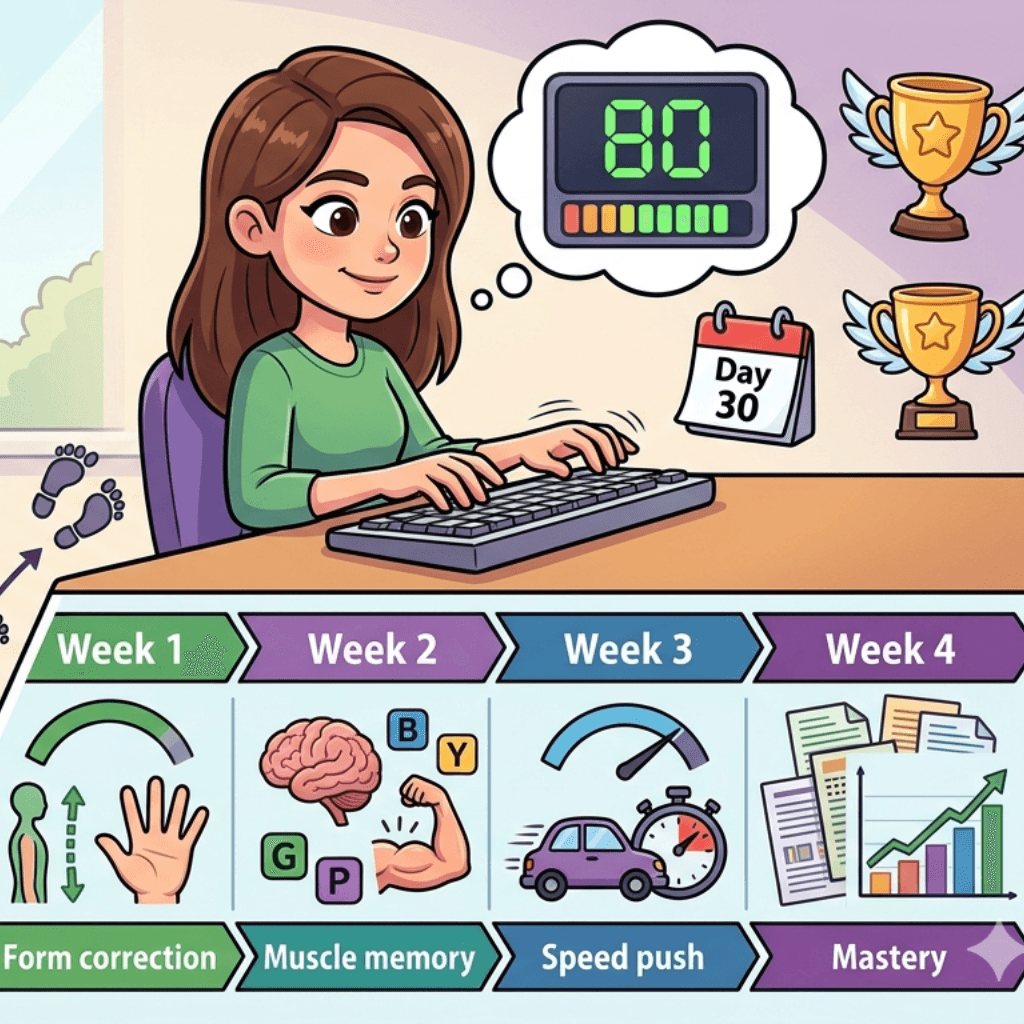
Week 1 — Stop the Bad Habits First
Before you get faster, you have to get right. Almost every slow typist has at least one of these problems going on:
- Looking at the keyboard while typing — this is the biggest one.
- Sitting in a weird position that strains your hands.
- Using three or four fingers instead of all ten.
- Resting wrists flat on the desk while typing.
This week, fix all of that. Put both hands on the home row — left on ASDF, right on JKL — and do not move them off. Practice for 20 minutes daily on any free typing platform. You will be slow. That is completely fine. The goal this week is not speed. The goal is correct form.
By day 7, your fingers will start recognising key positions without you having to think too hard.
Week 2 — Train Your Fingers to Remember
This week is about muscle memory. Your fingers need to stop thinking and start just knowing. Here is what works:
- Type the top 200 most common English words repeatedly.
- Drill the keys you keep missing — for most people, it is B, Y, G, or P.
- Move from random words to full sentences.
- Take short 1 to 2 minute timed tests and write down your WPM each day.
- Do not rush for speed yet. Every mistake sets you back more than you think.
A lot of people jump from 30 WPM to 45 or even 50 WPM just in this week alone. Muscle memory is powerful once it starts building up.
Week 3 — Now Push the Speed
Accuracy is decent now. Time to push. This week, you deliberately type faster than feels comfortable. That slight discomfort is how limits get broken.
- Take a 1-minute test every single day and log your score.
- Practice with full paragraphs, not just word lists.
- Play a fast-finger typing game — it makes the whole thing more engaging.
- Push your speed by 5 WPM more than your usual pace.
- Rest your hands for 5 minutes after every 20 minutes of practice.
Most people land somewhere between 55 and 65 WPM by the end of this week. That is already a number that would impress most employers.
Week 4 — Cross 80 and Stay There
The last stretch. This week is less about learning and more about locking in what you have built.
- Switch to 3-minute tests instead of 1-minute ones — they show your real speed.
- Type actual content — news articles, blog posts, anything that uses normal language.
- Work on weak spots specifically — numbers, symbols, capital letters at the start of sentences.
- Track your average WPM across all tests, not just your best score.
- Keep celebrating little progress. 70 WPM is genuinely impressive.
After 30 days of daily honest practice, 80 WPM stops being a dream and becomes your new normal.
Mistakes That Kill Your Progress
Some people practise every day and still do not improve. Usually, it is because of one of these:
- Still peeking at the keyboard — You have to stop this completely and permanently.
- Chasing speed before fixing accuracy — High speed with low accuracy is pointless.
- Skipping practice for 3 or more days in a row — Muscle memory fades fast.
- Typing with only 2 or 4 fingers — All ten fingers need to be in the game.
- Never write down WPM scores — You cannot improve what you do not track.
Small Habits That Help You Increase Typing Speed Faster
These are not big changes. They are tiny habits that quietly make a big difference over 30 days:
- Reply to WhatsApp messages and emails from your laptop keyboard, not your phone.
- Start each session with 2 minutes of warm-up — just type A to Z slowly.
- Invest in a decent keyboard if possible. Typing on a bad keyboard adds unnecessary friction.
- Set a phone reminder for practice time. Willpower alone does not work.
- Get a friend to compete with you. Even a small rivalry helps you stay consistent.
One Last Thing
To increase typing speed in a real way, you only need three things working together — the right technique, daily practice, and the patience to not quit on day 12 when progress feels slow.
The people who reach 80 WPM are not born with fast fingers. They are just people who kept showing up. Same keyboard, same 26 keys, same fingers — just more practice time.
Open a typing test, check your current WPM right now, and write it down. That number is your starting point. Thirty days from today, compare it and see what consistent practice actually does.
You can start practising right away on FastFingers.in and track your daily progress.